Molecular & experimental
Immunohistochemistry, fluorescence assays, plasmid work, rodent behavioral assays
Computational models for biological systems.
I move across molecules, neural circuits, and behavior to ask what mechanisms sit behind what we observe.
Reinforcement learning for visually guided gap-crossing behavior in a physically simulated rodent.
SENIOR THESIS · 2026–27Connecting energetic constraints with the cancer mutational landscape.
MELÓN LAB · 2025Frequency-specific communication between VTA and PFC under ethanol exposure.

I am a senior at Wesleyan University studying Biology, Mathematics, and Integrative Sciences. Biology gives me systems worth understanding; mathematics gives me ways to formalize them; computation gives me another way to experiment.
Outside the analysis, drawing, teaching, and travel keep changing what I notice—and how I explain it to someone else.
Across molecules, neural circuits, and behavior, I use computational models to ask what observed patterns can—and cannot—tell us about biological systems.
I am especially interested in analyses that keep neural dynamics tied to behavior, rather than treating signal processing as a detached technical exercise.
I care about models most when they help clarify what is being learned, which is why interpretability has become central rather than optional in my ML work.
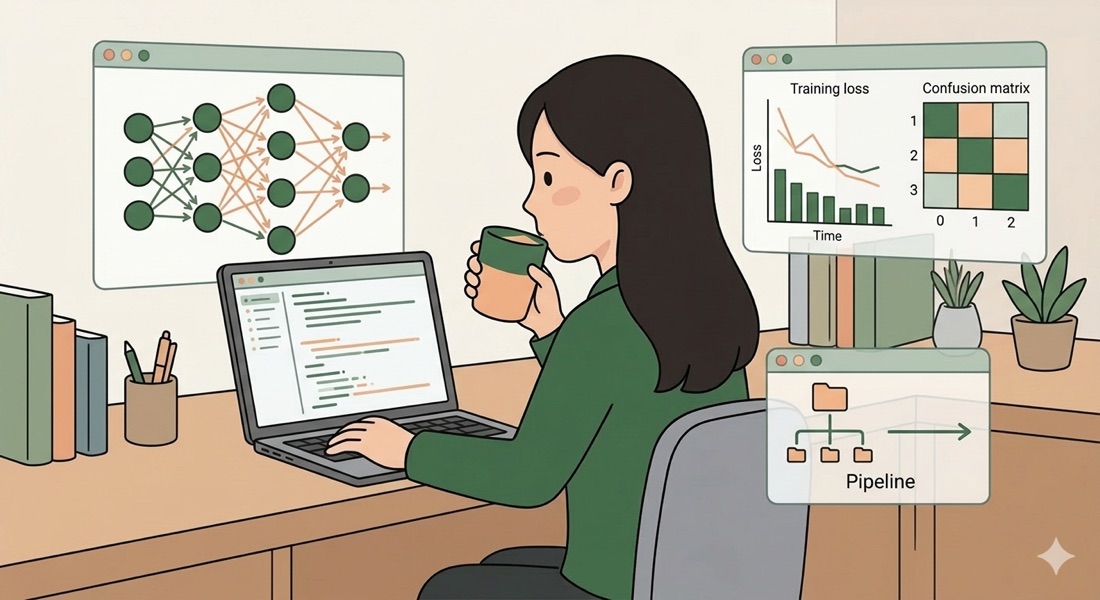
A recurring part of my work is turning messy analysis into reusable structure: cleaner code, better figures, and pipelines that remain legible when the question evolves.

I’m most drawn to research that connects neural data, behavior, and interpretation, especially when the analysis itself becomes part of the scientific question rather than just a way of presenting the answer.
Biology, Mathematics, and Integrative Sciences at Wesleyan • moving toward graduate work in computational neuroscience
Reinforcement-learning experiments testing how a physically simulated rodent crosses gaps, responds to visual changes, and stops at uncrossable gaps.
Token-level SHAP analysis across three transformer-based models to examine which linguistic features contribute to automated originality scores.
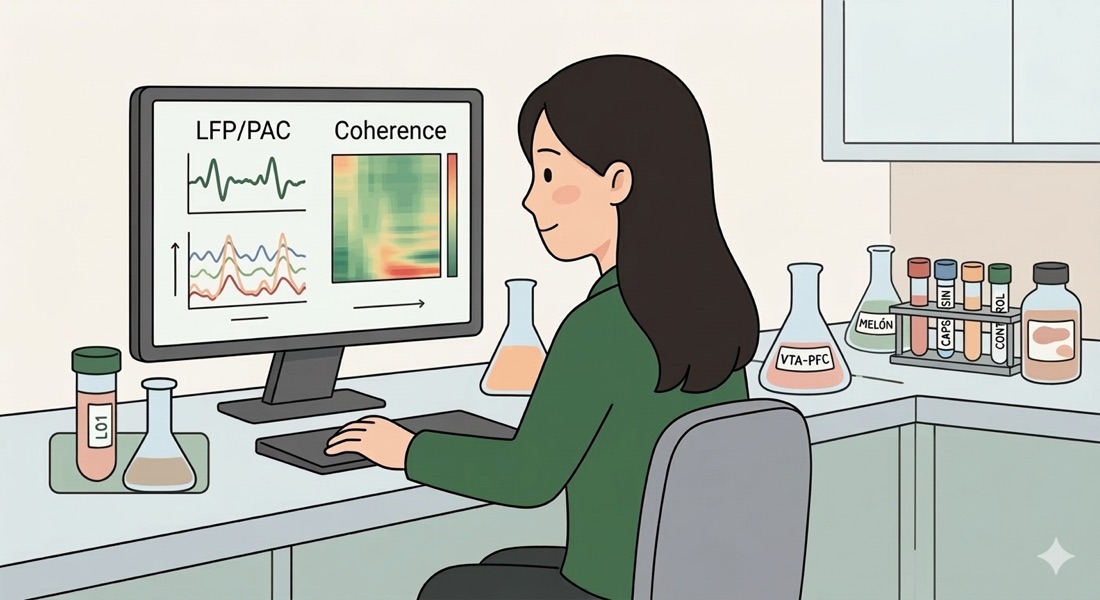
Event-aligned LFP analysis of VTA-PFC coordination using PSD, coherence, PAC, and Granger causality in the context of social behavior and ethanol exposure.
Salk Institute / Virtual-rat behavior
Neural dynamics
VTA–PFC activity during social interaction and ethanol exposure.
View researchModel interpretation
Token-level SHAP analysis across three transformer models.
View researchAI4ALL Ignite / Respiratory audio
Nanjing University / Experimental biology
Molecular mechanisms / Thesis in progress
Energetic constraints on the p53 cancer mutational landscape.
View thesisGenetic networks
Boolean networks, attractor states, and sensitivity to change.
Explore the modelExplore the labs and training behind the work. Select an experience to follow its story.
Immunohistochemistry, fluorescence assays, plasmid work, rodent behavioral assays
Spike trains, spectral analysis, coherence, PAC, Granger causality
Regression, mixed-effects models, ANOVA, cross-validation
Reinforcement learning, CNNs, LSTMs/BiGRUs, transformers, SHAP
COMPUTING FOUNDATION Python · MATLAB · R · NumPy · Pandas · scikit-learn · PyTorch · TensorFlow · Linux/Unix · HPC/Slurm
Question: What does a reinforcement-learning policy use to cross gaps, and can it learn when not to jump?
Approach: Varied rewards, visual input, gap width, starting position, and evaluation conditions in a physically simulated rodent.
I added Gaussian noise to the virtual rat’s visual observations to test sensitivity to visual perturbation. Explore the image transformation below.
Demo only: Gaussian noise is added to pixel values and clipped to the display range. The image and noise strengths are illustrative—not experimental frames or the study’s calibrated noise levels.
The 12–28 cm range matches the project’s gap settings. Geometry is schematic, not to scale.
How sensitive is gap-crossing behavior to Gaussian noise added to the visual observations?
The visual scene remains present; its pixel values are perturbed. This illustration shows the input manipulation, not the policy’s response.
For a visual comparison, keep the gap fixed and change the noise strength.
Summer Undergraduate Research Fellow in the Talmo Lab and Salk Center for AI and Research Computing, June–August 2026. Selected as 1 of 10 Salk SURF fellows.
The project shifted the question from whether the virtual rat could cross a gap to what information and reward structure supported the behavior. Gaussian visual-noise tests, starting-position changes, and uncrossable-gap conditions were used to investigate the strategy behind successful performance.
Presented “Eliciting Deliberation Before a Gap Jump in a Virtual Rat” at the Salk SURF Capstone and Talmo Lab research meeting in August 2026.
Question: How does ethanol alter VTA-PFC neural coordination during social interaction?
Approach: Analyzed approximately 8 hours of VTA-PFC LFP recordings from 24 mice using coherence, PAC, Granger causality, and mixed-effects models.
Result: Ethanol reduced theta-band VTA→PFC Granger causality while PFC→VTA connectivity remained comparatively stable.
A readout is useful only when its interpretation matches the question. Select a lens to see the distinction.
Conceptual reading guide, not a data visualization. A and B are generic signals; arrows do not depict this study’s findings.
Identified reduced theta-band VTA→PFC Granger causality under ethanol exposure while PFC→VTA connectivity remained comparatively stable. Presented at the Wesleyan Summer Experience Presentation in July 2025 and Research Pathways Showcase in January 2026.
What made this work especially interesting was that integrating behavior with neural analyses required more than stacking methods together; I had to keep revising the pipeline so the metrics remained interpretable in the context of the experiment rather than drifting into abstraction.
Question: Are creativity prediction models capturing genuine linguistic patterns or statistical artifacts?
Approach: Developed an HPC-based token-level SHAP pipeline for three transformer-based originality-scoring models.
Result: Found that token rarity alone did not explain originality attributions; semantic distance and token length also correlated with SHAP scores.
Illustrative values, not study data: brighter, longer bars show how token-level contributions can be visualized.
A novel response can feel precise without becoming too easy to predict.
Presented “An Analysis of Automated Creativity Scoring Models Using Explainable AI” with A. Tran at the Data Insights Student Speaker Series in March 2026.
What changed in my thinking during this project was that interpretability stopped feeling like a secondary add-on; it became the main way to tell whether the model was actually learning something meaningful.
This work highlights the critical need for interpretability in ML models applied to creative or subjective tasks. I'm particularly interested in how these methods can reveal the difference between genuine pattern recognition and dataset-specific artifacts, a distinction that matters across all ML applications in cognitive science.
Question: How far can cough-audio features support exploratory classification of COVID-19 status in a research setting?
Approach: A 430K-parameter CNN-BiGRU classifier with audio-quality filtering, augmentation, and spectral feature extraction across three public datasets.
Result: Across 5 folds and 6,624 samples, the model achieved 0.926 PR-AUC, 90.6% COVID-positive recall, and 0.892 F1.
Amplitude of the raw cough signal over time, similar to what you would see in a basic audio editor.
A compact spectral representation of respiratory audio used as input to the classifier.
Achieved 0.926 PR-AUC, 90.6% COVID-positive recall, and 0.892 F1 across five folds and 6,624 samples.
One challenge here was learning not to trust aggregate performance at face value when the underlying data were substantially imbalanced.
This project made me more careful about data imbalance, bias, and the difference between a promising model and a clinically meaningful one.
Question: Can we predict movement intention from pre-motor cortical activity?
Approach: A three-stage LSTM decoder using 567-dimensional MOp/MOs activity aligned to three behavioral events.
Result: Built a pipeline for classifying left-versus-right movement choices from cortical neural activity.
Completed as a Deep Learning Scholar at Neuromatch Academy in August 2025.
What kept me engaged was that decoding intention from temporal neural activity required thinking simultaneously about model design, data structure, and the timing of the behavior itself, rather than treating prediction as a purely engineering problem.
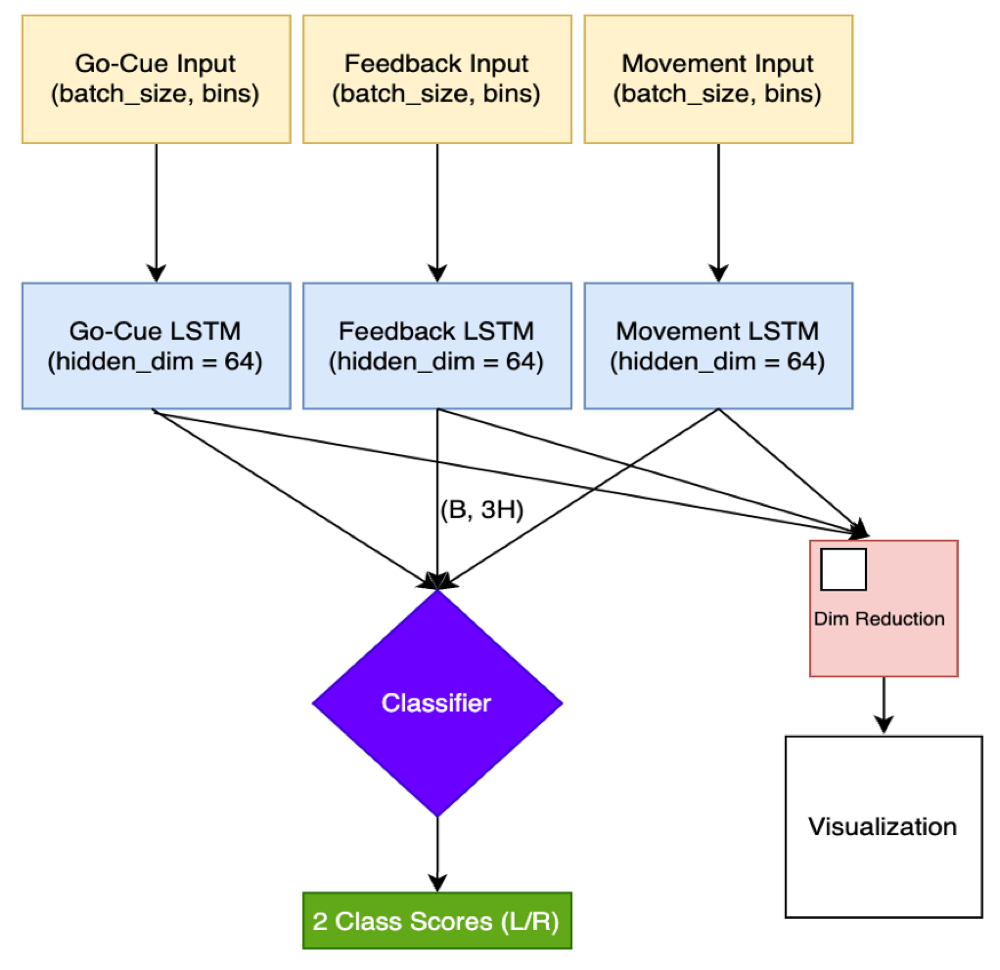
Overview of the LSTM decoding pipeline linking cortical spike trains to left/right movement decisions.
Raster plot animation illustrating neural population activity around movement initiation.
This project sharpened my interest in temporal neural data and in models that stay close to the structure of the behavior they are trying to decode.
Question: Can capsaicin treatment reduce anxiety-like behavior in chronically stressed mice?
Approach: 21-day chronic restraint stress model with behavioral assays and oxidative stress markers.
Result: The study examined whether capsaicin treatment was associated with reduced anxiety-like behavior and oxidative stress markers.
Combined behavioral assays with ROS fluorescence measurements to evaluate whether capsaicin could mitigate anxiety-like behavior and oxidative stress in a chronic-stress mouse model.
This project taught me early that careful experimental design matters most when the result is not guaranteed to be clean; the interpretation only became convincing when the behavioral and biochemical pieces could speak to each other.
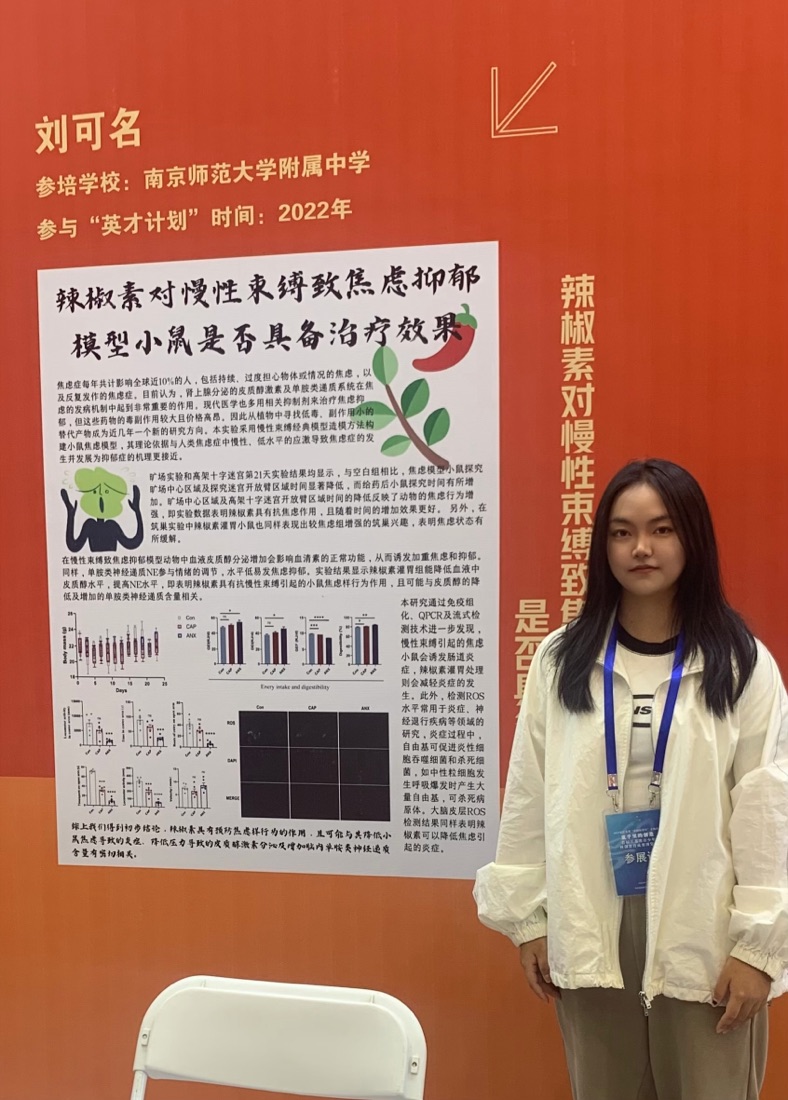
Presenting my work at the Jiangsu High School Students’ Science Symposium through a poster presentation.
This early research experience introduced me to the importance of rigorous experimental design and statistical analysis in neuroscience. It sparked my interest in understanding the biological mechanisms underlying behavioral change, a theme that continues in my current computational work on neural circuit dynamics.
Question: How do energetic constraints shape which p53 mutations appear in cancer?
Approach: Integrating computational mutagenesis with cancer mutation data.
Status: Senior thesis in progress at Wesleyan University.
This project brings together my interests in computational modeling and biological mechanism. The analysis is ongoing, so the site describes the research question and approach without presenting preliminary results as conclusions.
Question: How sensitive are genetic regulatory networks to mutations across different attractor states?
Approach: Simulated Kauffman Boolean networks with mutation sensitivity analysis on local machines.
Result: Explored attractor-dependent vulnerability patterns and the computational trade-offs involved in scaling the simulations.
Toy copy-rule network · not the study’s network or results
At each step, all nodes update together: A copies C, B copies A, and C copies B. Toggle a starting state, then follow it through time.
This changes an initial state, not a gene or update rule. It illustrates an attractor cycle—not biological propagation.
What I found compelling here was how quickly a simple model can become difficult to reason about at scale, which made computational efficiency and conceptual clarity feel like part of the same problem.
Different attractor states showed varying degrees of sensitivity to mutations, suggesting that network topology and current state jointly determine robustness. Some attractors were remarkably stable, while others were highly vulnerable to single-node perturbations. This has implications for understanding biological robustness and evolvability.
This project taught me the importance of computational efficiency in large-scale simulations, even when running on local machines. What started as a straightforward modeling question became an exercise in thinking about optimization and potential future scaling. I'm interested in extending this approach to more realistic network topologies informed by empirical gene regulatory data, and exploring how network structure shapes evolutionary dynamics.
On making things,
questioning them,
and being changed by others.
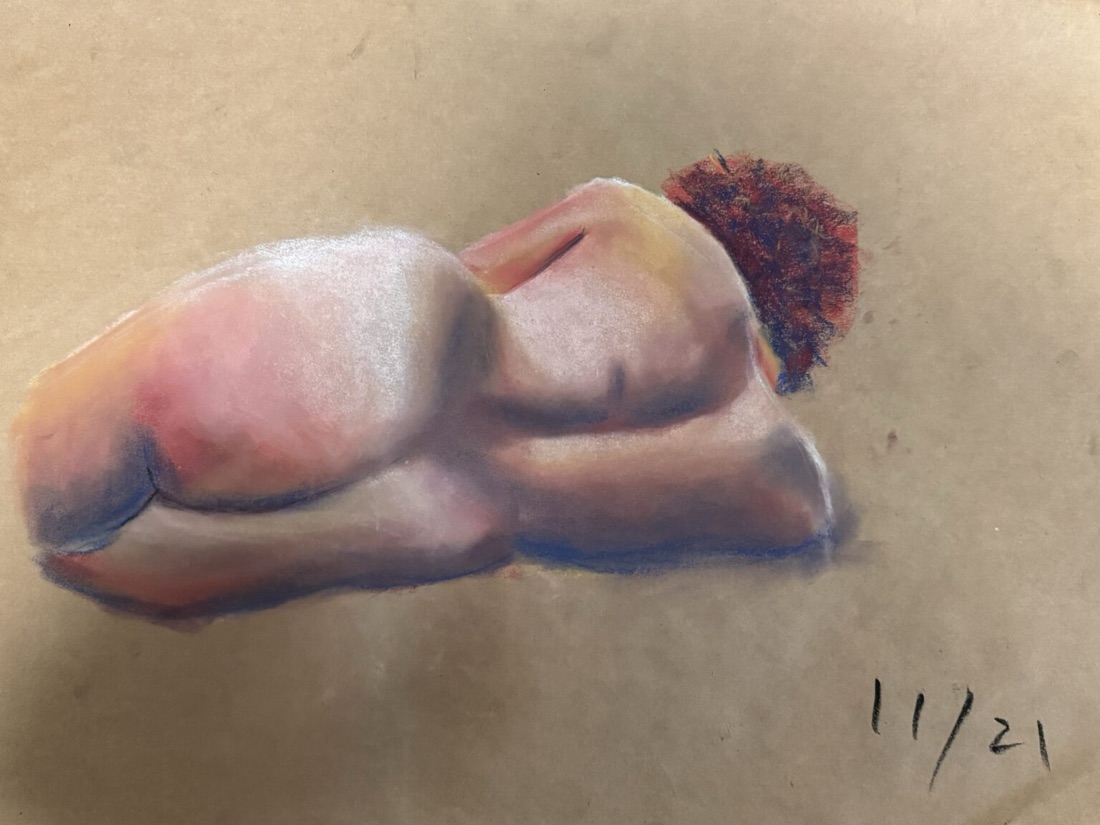
What if working harder is part of what makes a drawing stiff?
Read the essayMaking an analysis repeatable is not the same as making its interpretation right.
Read the essay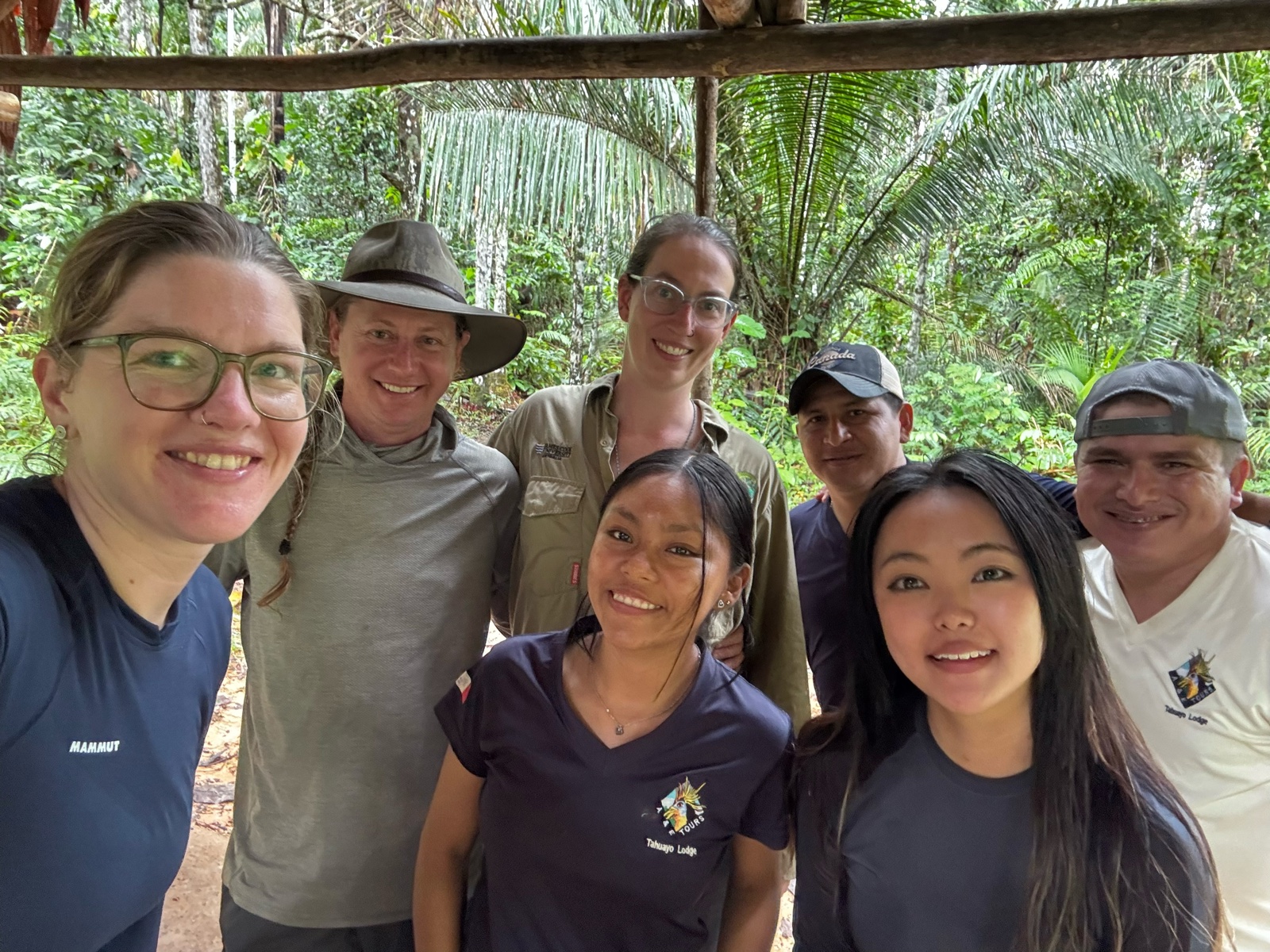
A returned phone. A table in the rainforest. A bracelet that outlasted the encounter.
Read the essay They did not solve anything for me.Written between the work. Not everything needs to become a result.